Draft Resisters Tell Of Pain: WWII Disloyalty Charges Still Haunt Internees

By Art Campos

Sacramento Bee Staff Writer

2/24/1993

Page B1

METRO FINAL

Mits Koshiyama and Frank Emi waited nearly 50 years to tell their side of the story.

As young men, the two Japanese Americans were sent to the Heart Mountain internment camp in Wyoming with their families when World War II broke out. Stripped of their constitutional rights, they were then asked to defend their country by being drafted into the army.

Both said no. Both ended up in prison.

“The government was asking us to fight for the very freedoms that were being denied to us,” said Koshiyama, 68, of San Jose. “It was unjust.”

“Had we stayed quiet and gone along with it, nothing would have happened,” said Emi, 76, a resident of San Gabriel. “But the government went too far suppressing our rights. Then they added insult to injury by drafting us.”

For standing by their convictions, the two men have lived most of their lives branded as “troublemakers” by a segment of the Japanese American community that felt the men should have served in the armed forces to prove their loyalty to the United States.

In 1947, President Harry S. Truman pardoned Koshiyama and 262 other Japanese Americans who were convicted and placed behind bars for refusing to be inducted into the armed forces. Emi and six other leaders of a group calling itself the Fair Play Committee had their convictions overturned on appeal.

But to this day, a huge rift continues to exist in the Japanese American community between supporters of the draft resisters and those who felt the protesters were disloyal.

On Tuesday, the subject was discussed in a forum at California State University, Sacramento. Koshiyama and Emi were panelists and they recounted their stories for about 100 listeners. Continue reading
Posted in Uncategorized | Leave a comment

Interned and shunned during war: Japanese Americans recall their resistance

By Ted Bell

Sacramento Bee Staff Writer

5/10/1992

B1 METRO

They were cast out by the outcasts.

They are the Japanese-American men who refused to fight in World War II after the U.S. government interned them and their families in camps.

Stigmatized by U.S. society that imprisoned them and called them disloyal Americans for resisting the draft, they were also pariahs to other interned Japanese-Americans – the families that sent husbands and brothers to the Army’s renowned 442nd Regimental Combat Team.

The resisters remained outcasts for years, condemned by the Japanese-American Citizens League. Still, men from the Amache Relocation Camp near Grenada, Colo., who resisted and served their prison time in Tucson, Ariz., have met quietly for reunions in Sacramento for years.

On Saturday, joined by some of the men from the Heart Mountain, Wyo., camp, a group of 25 went to the Sacramento History Museum to examine the exhibit on Japanese-Americans, including a special display on the war years.

Noboru Taguma peered at a photograph of himself taken more than 50 years ago. Terry Uyemoto turned away from the others to be inconspicuous as he wiped the tears from his eyes and his memories. Continue reading

Posted in Uncategorized | Leave a comment

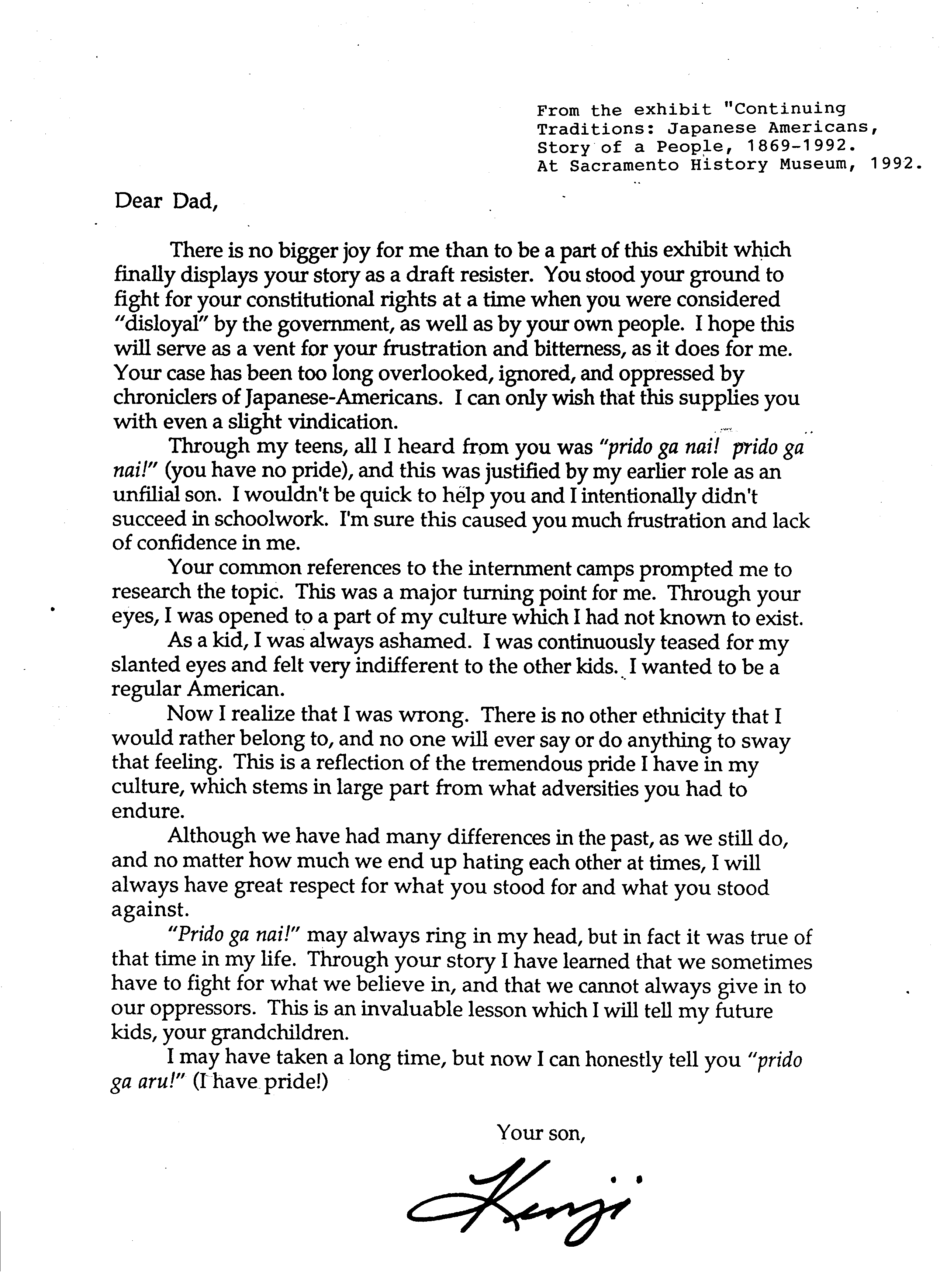
Letter to Dad, Sacramento History Museum exhibit on the Japanese American experience, 1992

Posted in Uncategorized | Leave a comment

50 years later, memories of internment remain painful

By Jeannie Wong

Sacramento Bee Staff Writer

2/17/1992

A1 MAIN NEWS

“PERSONAL JUSTICE DENIED’ – EXECUTIVE ORDER 9066

Their diaries are brittle and stained now, their memories misty and fleeting. But for many Japanese-Americans, it is all they have left of a time that was snatched away from them.

The nightmare began Feb. 19, 1942.

As World War II engulfed and enraged this nation, that was the date 50 years ago this week that President Franklin Delano Roosevelt signed Executive Order 9066, which mandated the uprooting and internment of 120,000 people of Japanese ancestry along the West Coast – U.S. citizens and their immigrant parents alike.

The act was to send a collective shudder through subsequent generations. Homes, livelihoods and pride were irretrievably lost. So great was the cost that half a century later, families still mark their lives as the time before camp, and the time after it. Continue reading

Posted in Uncategorized | Leave a comment